Peptides for weight loss have gone from a niche research topic to a dinner-table conversation in just a few years, largely on the back of drugs like semaglutide and tirzepatide. If you’ve seen the term thrown around online and aren’t sure which peptides are actually backed by clinical trials versus which are unproven compounds sold for “research use only,” this guide breaks down the real evidence, the mechanisms, and what to weigh before considering any of them.
📌 What are peptides for weight loss? Peptides for weight loss are short chains of amino acids that influence appetite, metabolism, or fat storage. The best-known group — GLP-1 receptor agonists like semaglutide and tirzepatide — are FDA-approved prescription drugs shown in trials to produce 15–22% body weight loss. Others remain research-only compounds with far less clinical evidence.
What Are Peptides and How Do They Work for Peptides for Weight Loss?
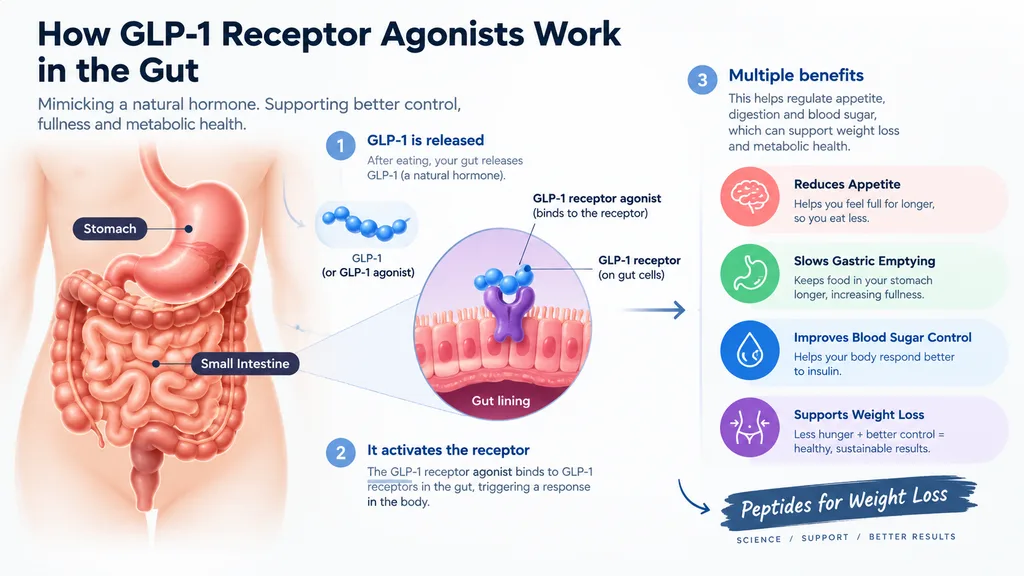
Peptides for weight loss work by mimicking hormones your gut already produces after eating — mainly GLP-1, a hormone that slows digestion, curbs appetite, and helps regulate blood sugar. By copying that signal, these drugs make people feel full sooner and eat less over time.
Peptides are simply short chains of amino acids — smaller and more targeted than full proteins. In weight management, most of the attention goes to a subclass called incretin mimetics, which copy gut hormones involved in digestion and satiety. Semaglutide and tirzepatide are the two most studied names in this category, but they work slightly differently:
- Semaglutide mimics GLP-1 alone
- Tirzepatide mimics both GLP-1 and GIP (glucose-dependent insulinotropic polypeptide), giving it a dual mechanism
- Retatrutide, still in trials, adds a third hormone pathway (glucagon) into the mix
In my experience reviewing client-facing health and wellness content for search visibility, the biggest misconception readers have is treating “peptide” as one single category. It isn’t — the evidence, safety profile, and regulatory status are completely different depending on which specific peptide is being discussed.
Which Are FDA-Approved Peptides for Weight Loss?
Only a handful of peptides for weight loss are FDA-approved prescription medications: semaglutide (Wegovy, Ozempic), tirzepatide (Zepbound, Mounjaro), and liraglutide (Saxenda). Everything else — including popular “research peptides” — lacks that regulatory approval.
For readers exploring peptides for weight loss, it’s important to distinguish FDA-approved medications from research-only compounds and understand the evidence behind each category.
Semaglutide first received FDA approval for type 2 diabetes, then a higher-dose formulation was approved for long-term weight management in 2021 marking the first major pharmacological advance in obesity treatment in years. Tirzepatide followed a similar path, first approved for diabetes before its weight-management approval.
FDA-Approved Weight Loss Peptides at a Glance:
| PeptideBrand NamesMechanismFormat | |||
|---|---|---|---|
| Semaglutide | Wegovy, Ozempic | GLP-1 receptor agonist | Weekly injection, daily oral |
| Tirzepatide | Zepbound, Mounjaro | GLP-1 + GIP dual agonist | Weekly injection |
| Liraglutide | Saxenda | GLP-1 receptor agonist | Daily injection |
An oral form of semaglutide also expanded availability in early 2026, giving people who prefer not to inject weekly another route into GLP-1 therapy, though pricing and insurance coverage still vary widely by plan and pharmacy.
What Research-Stage Peptides Are People Talking About?
Beyond the approved drugs, several research-stage peptides for weight loss are circulating in wellness and biohacking circles — but they carry meaningfully less evidence. Retatrutide, tesamorelin, CJC-1295, AOD-9604, and MOTS-c fall into this bucket.
- Retatrutide is in Phase 3 trials (the TRIUMPH program) after promising Phase 2 results; if confirmed, researchers believe it could outperform current GLP-1 drugs on weight loss magnitude
- CagriSema, which pairs semaglutide with the amylin analog cagrilintide, reported strong early trial results but failed to beat tirzepatide in a 2026 head-to-head study
- Tesamorelin is studied specifically for reducing visceral fat around organs rather than overall body weight
- AOD-9604 and MOTS-c target fat metabolism through different, less-established pathways and are typically sold for research purposes only, not human consumption
⚠️ Compounds labeled “research use only” have not gone through the clinical trials or manufacturing oversight that FDA-approved drugs have, and their real-world safety data in humans is limited.
How Effective Are GLP-1 Peptides for Weight Loss?
Clinical trial data for GLP-1 peptides shows the strongest and most consistent results of any weight-loss drug class studied to date, with participants losing 15–22% of body weight over roughly a year of treatment.
A systematic review comparing GLP-1 agonists found semaglutide performed favorably against other drugs in its class for both weight loss and safety profile, and a real-world cohort study of over 2,300 patients in a multidisciplinary obesity clinic confirmed meaningful weight loss outside of controlled trial settings too — though the same study noted that inconsistent dose titration and treatment persistence often blunt real-world results compared to trial conditions.
According to a 2026 peer-reviewed body composition study (the SEMALEAN trial), patients on semaglutide lost an average of 10% of body weight at seven months and 13% at twelve months, with nearly 60% of participants achieving 10% or greater weight loss — while the study also tracked lean muscle mass to understand trade-offs beyond the scale.
Key Takeaways From the Clinical Data
- GLP-1 peptides consistently outperform diet-only approaches in trials
- Dual and triple-hormone peptides (tirzepatide, retatrutide) are trending toward even stronger results
- Real-world outcomes depend heavily on consistent dosing and medical supervision — not just the drug itself
What Are the Side Effects and Risks of Peptides for Weight?
The most common side effects of GLP-1 peptides for weight loss are gastrointestinal — nausea, constipation, and diarrhea are the most frequently reported, especially during dose escalation.
Because these drugs slow digestion, most side effects cluster around the gut. Doses are typically started low and increased gradually specifically to reduce this burden. Less common but more serious risks include gallbladder issues and, in rare cases, pancreatitis — which is why prescribing guidelines call for medical screening before starting treatment and monitoring throughout.
Research-stage and compounded peptides carry an added layer of risk: without FDA oversight of manufacturing, purity and dosing can vary between suppliers, and long-term human safety data is often thin or nonexistent.
Prescription vs Compounded Peptides: What’s the Difference?
Prescription peptides for weight loss are manufactured, tested, and dosed under FDA oversight and require a doctor’s prescription. Compounded versions are custom-mixed by pharmacies, often at lower cost, but with less consistent regulatory oversight.
Compounding became especially common during the supply shortages that followed the explosive early demand for semaglutide and tirzepatide, when telehealth platforms began offering compounded alternatives at lower price points. That gap has narrowed as manufacturers scale up supply, but the cost and access trade-offs between prescription-brand and compounded routes are still a major factor in how people decide where to start.
Prescription vs Compounded — Quick Comparison:
| FactorPrescription (Brand)Compounded | ||
|---|---|---|
| Regulatory oversight | FDA-approved | Pharmacy-compounded, less standardized |
| Cost | Higher, insurance-dependent | Often lower, typically out-of-pocket |
| Consistency | Standardized dosing | Can vary by pharmacy |
| Access | Doctor + pharmacy | Often telehealth-based |
How Do You Access Peptides for Weight Loss Safely?
The safest way to start peptides for weight loss is through a licensed physician who can evaluate your health history, order relevant labs, and monitor you through dose escalation — rather than sourcing research-only compounds independently.
A doctor-supervised path typically starts with a consultation (in person or via telehealth), a review of medical history and current medications, and a starting dose that increases gradually over weeks or months based on tolerance and results. This is also the only path that includes monitoring for the rarer but more serious side effects mentioned above.
What are the best peptides for weight loss right now?
Among FDA-approved options, tirzepatide and semaglutide currently show the strongest clinical results, with trial participants losing 15–22% of body weight. Among research-stage compounds, retatrutide is generating the most attention heading through Phase 3 trials.
Do peptides for weight loss actually work?
FDA-approved GLP-1 peptides have strong trial and real-world evidence behind them, with consistent double-digit percentage weight loss reported across multiple studies. Non-prescription research peptides have far less evidence supporting comparable results.
Are peptides for weight loss safe?
FDA-approved peptides are generally considered safe under medical supervision, with gastrointestinal side effects being most common. Compounded and research-only peptides carry more uncertainty due to inconsistent manufacturing oversight and limited human safety data.
How much weight can you lose on GLP-1 peptides?
Clinical trials report average weight loss between 15% and 22% of starting body weight over roughly a year, though real-world results vary based on dose consistency and individual response.
What is the difference between semaglutide and tirzepatide?
Semaglutide mimics one gut hormone (GLP-1), while tirzepatide mimics two (GLP-1 and GIP), which is part of why some trials show slightly stronger average results for tirzepatide.
Can you buy peptides for weight loss without a prescription?
FDA-approved peptides require a prescription. Some research-stage peptides are sold online labeled “for research purposes only,” but these are not approved for human use and carry meaningfully higher risk.
How long does it take to see results from weight loss peptides?
Most people begin noticing appetite changes within the first few weeks, with meaningful weight loss typically becoming visible over 3–6 months as the dose is gradually increased.
Conclusion
Peptides for weight loss aren’t a single product — they’re a spectrum ranging from rigorously tested, FDA-approved medications to early-stage research compounds with limited human data. To recap:
- FDA-approved GLP-1 peptides (semaglutide, tirzepatide) have the strongest evidence, with trial-backed weight loss of 15–22%
- Research-stage peptides like retatrutide show promise but haven’t completed the same evidence ladder
- Medical supervision matters more than which peptide you choose — it’s what separates a monitored, dose-adjusted program from an unregulated one
If you’re weighing your options, the most actionable next step is a conversation with a licensed provider who can review your history and match a plan to your actual health profile, rather than starting from a compound’s marketing claims.